The Music & Song of Iveragh
A lot of material has been digitised and added to the website over the last six months due to a grant from ‘The Heritage Council’. The work of Binneas is ongoing and more material will be added to the site. Donations of recordings, photographs and other material are welcome.
LATEST
What's New
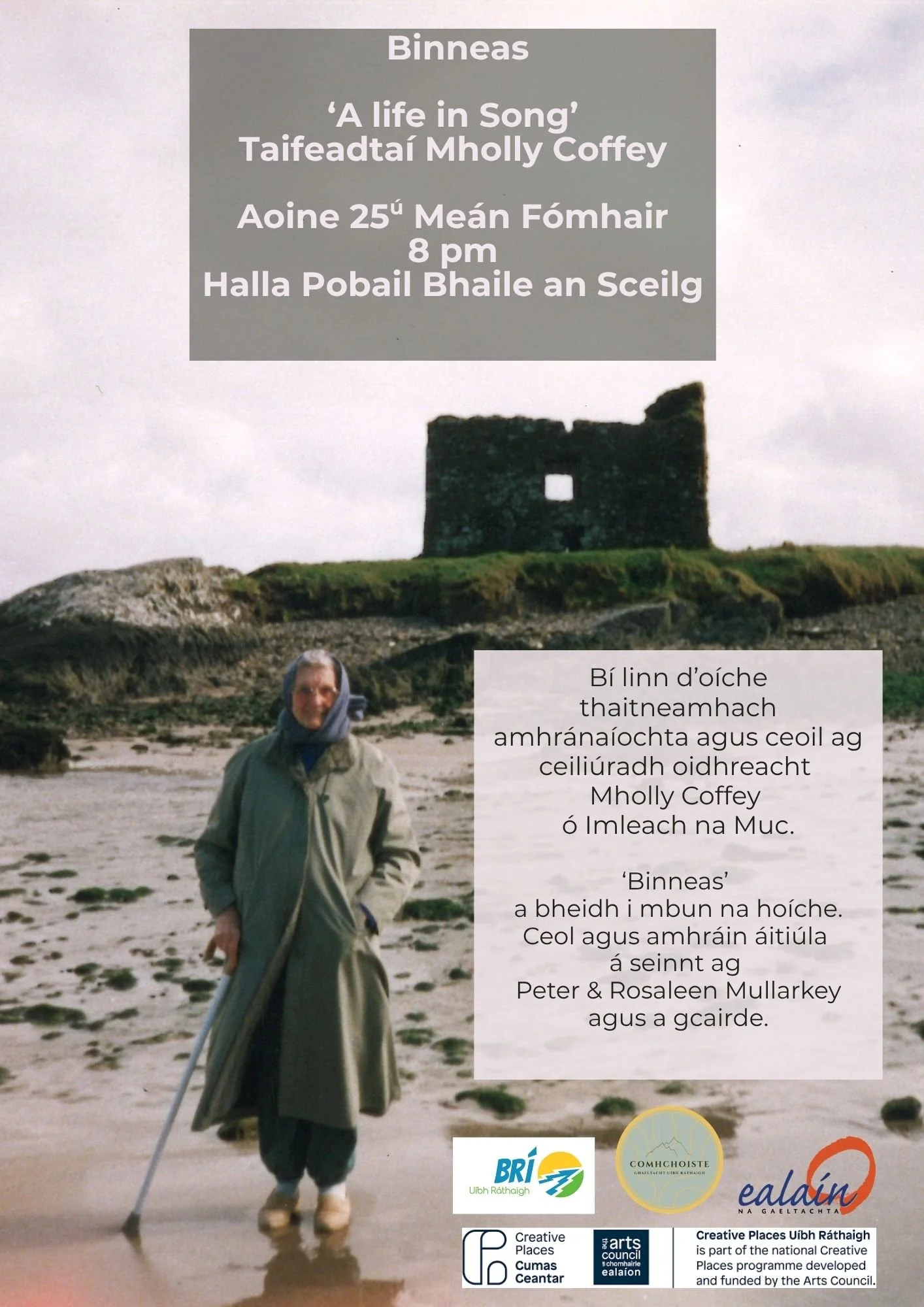
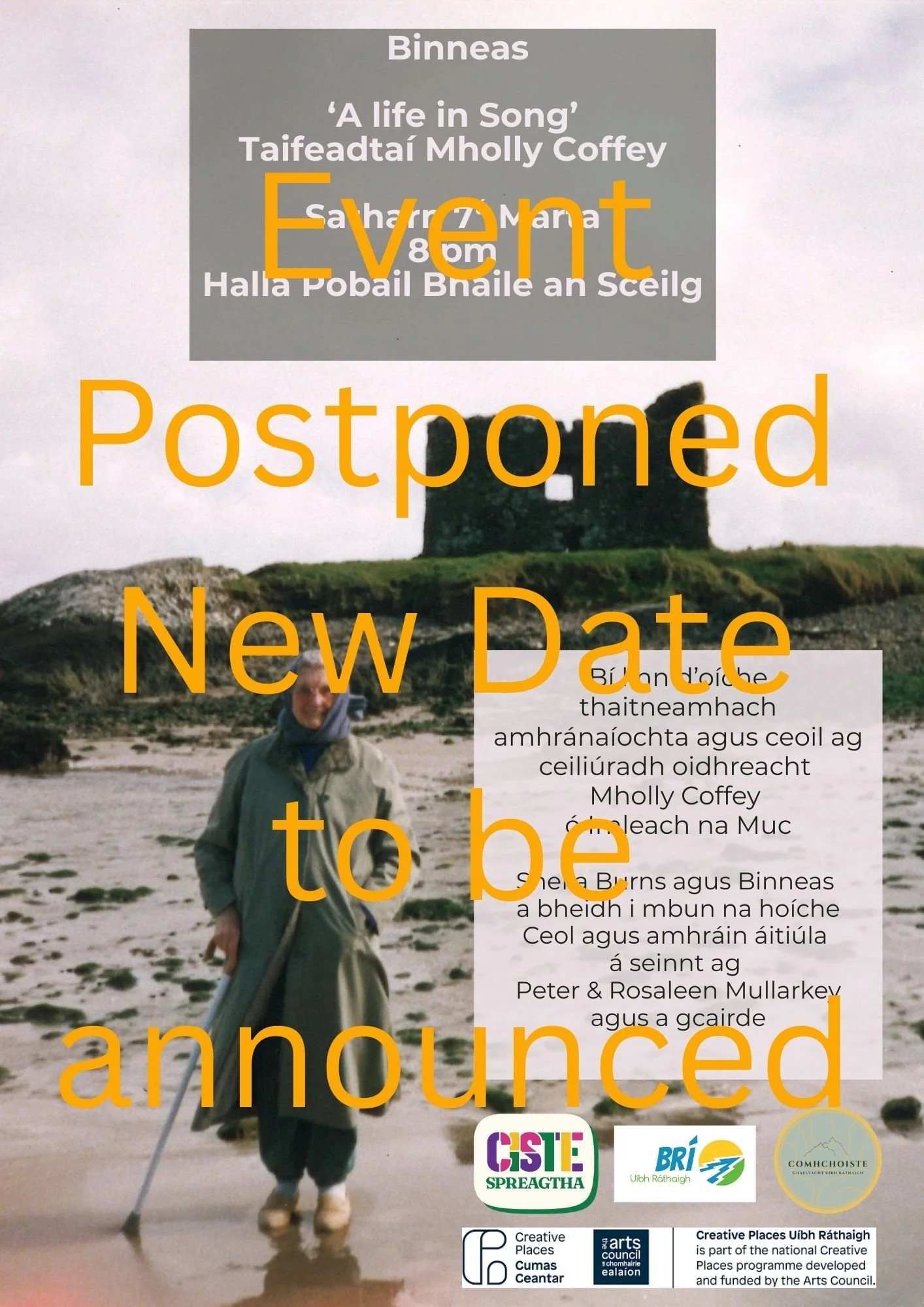
Binneas ‘A life in Song’ Taifeadtaí Mholly Coey
Satharn 7ú Márta, 8pm Halla Pobail Bhaile an Sceilg
Bí linn doíche thaitneamhach amhránaíochta agus ceoil ag ceiliúradh oidhreacht Mholly
Coey ó Imleach na Muc
Sheila Burns agus Binneas a bheidh i mbun na hoíche
Ceol agus amhráin áitiúla á seinnt ag Peter & Rosaleen Mullarkey agus a gcairde
Éigse na Brídeoige 2026
An File a Shéid Isteach: Paddy Bushe as an Iveragh Writer
Click the link to view the program - https://www.eigsenabrideoige.com
Amhrán A Bhríd a Mhuire na nGael - Rosaleen Mullarkey (Recorded live at the 25th Éigse)
The night of the big wind ‘Oíche na Gaoithe Móire’.
Was the most devastating storm ever recorded in Irish history. The hurricane of 6th and 7th January 1839 made more people homeless in a single night than all the sorry decades of eviction that followed it. The calm before the Big Wind struck was particularly eerie. Most of the eight million people living in Ireland at the time were preparing themselves for Little Christmas, the Feast of the Epiphany.
The 5th had seen the first snowfall of the year; heavy enough for some to build snowmen. By the following day, Sunday morning was unusually warm along the west coast and the air was still. At approximately 3pm, the rain began to fall and the wind picked up. Nobody could possibly have predicted that those first soft raindrops signified an advance assault from the most terrifying hurricane in human memory. By 6pm, the winds had become strong and the raindrops were heavier, with occasional bursts of hail and sleet. From the West an increasingly loud rumble could be heard.
By 10pm, Ireland was in the throes of a ferocious cyclone that would continue unabated until 6am. The hurricane had roared unmolested across 3,000 miles of Atlantic Ocean, gathering momentum every second. It hit Ireland’s west coast with such power that the waves actually broke over the top of the Cliffs of Moher. Reading contemporary accounts, the impression is that if Ireland did not have such magnificent cliffs forming a barrier along our west coast, the entire country would simply have been engulfed by water.
Stories of the events that night were shared by story-tellers up to modern times.
‘The talking Jackdaw’ is one such story told by Matt Joe O’Neill from the Binneas Collection that can be heard here.
Nollaig Shona daoibh go léir
The Kerry Christmas Carol
(Sigerson Clifford)
Artist: Rosaleen Mullarkey
Consider giving the gift of Music & Song this Christmas from the ‘Binneas Collection’.
Visit the Binneas shop - www.binneas.ie/shop
A new section to the Binneas Website ‘Songs of Tomás Rua Ó Súilleabháin’ to mark the 240th anniversary of his birth.
De réir an bhéaloidis d’fhuadaigh na síoga triúr dreiféar as móinéar ar an dtaobh thiar de Ghóilín lá breá fómhair. Cuireadh bean acu go ceantar an Daingin, bean eile go Cill Ó gCróin agus an triú bean go Clochán Mhóir atá ar an gcnoc lastuas do Mhálainn i bparóiste na Dromad. Mór a bhí mar ainm uirthi sin is bhíodh sí le feiscint ag Clochán Mhóir agus í síos suas an Caol ina sprid an mheán-lae. Deirtear go raibh folt breá gruaige ar dhath an óir ag sileadh léi. Is léir gurb é an seanchas seo a spreag Dónall Ó Curnáin ó Mhálainn an t-amhrán seo a chumadh. Bhí an fothrach ar a dtugtaí Clochán Mhóir suite ar an gcnoc lastuas dá thigh féin.
According to local tradition Mór was one of three sisters who was carried by the fairies as they were working in a meadow somewhere Over-the-Water. One sister was brought to Dingle, another to Killogrone, while Mór, the third sister was carried off to Málainn in the parish of Dromid. That sister had flowing golden hair and went by the name of Mór. A small stone hut on the mountainside, the ruins of which can still be seen today, is known as Clochán Mhóir. It was claimed that Mór could be seen as a mid-day spirit walking up and down along a nearby mountain stream. This legend inspired Dan Courtney from Malainn, in the composition of this song “Bean na Gruaige Buí.” The ruin of Clochán Mhóir is situated on the mountainside just above the house where Dan resided.
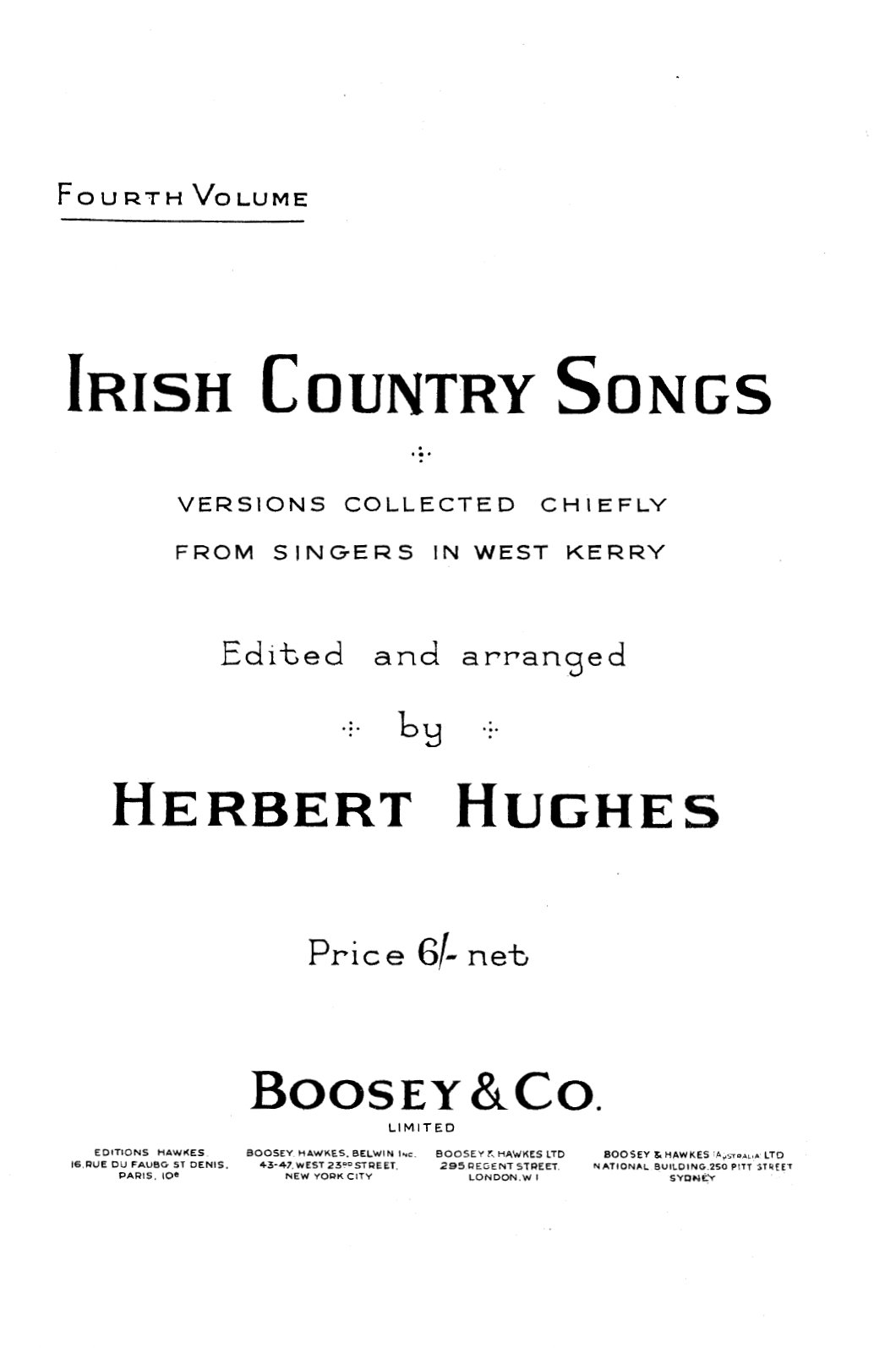
Can anyone help me find the location of Herbert Hughes’s diaries and journals, specifically his original field notes/notebooks from his Irish folksong-collecting trips. In particular, the material relating to ‘Irish Country Songs Volume 4 – 1936). Some of this material was collected in South Kerry.
A gentleman by the name of Christopher Orr gave a talk which was shown on Youtube I think, a few years back, about the song ‘She moved through the fair’. In his talk he refers to Herbert Hughes and as far as I can gather, he may be related. The information he had makes me think he had access to the field notes of Herbert Hughes.
Please share with anyone who might be able to help.
Many thanks.